
Historic Sites Near Savannah, GA: 8 Places to Visit Beyond Downtown
Savannah’s squares get most of the attention, but some of the region’s most important history sits a short drive from downtown. Within about 40 minutes of the Historic District, you can climb Georgia’s oldest and tallest lighthouse, walk the ruins of a colonial estate from the 1730s, stand inside the fort that changed military history in 1862, and learn about a Gullah Geechee community on the banks of the Moon River.
So what are the best historic sites near Savannah, GA? These seven places tell the story of coastal Georgia from its founding through the Civil War and into the 20th century. Each one is easy to reach by car, and most can be paired together for a half day or full day trip.
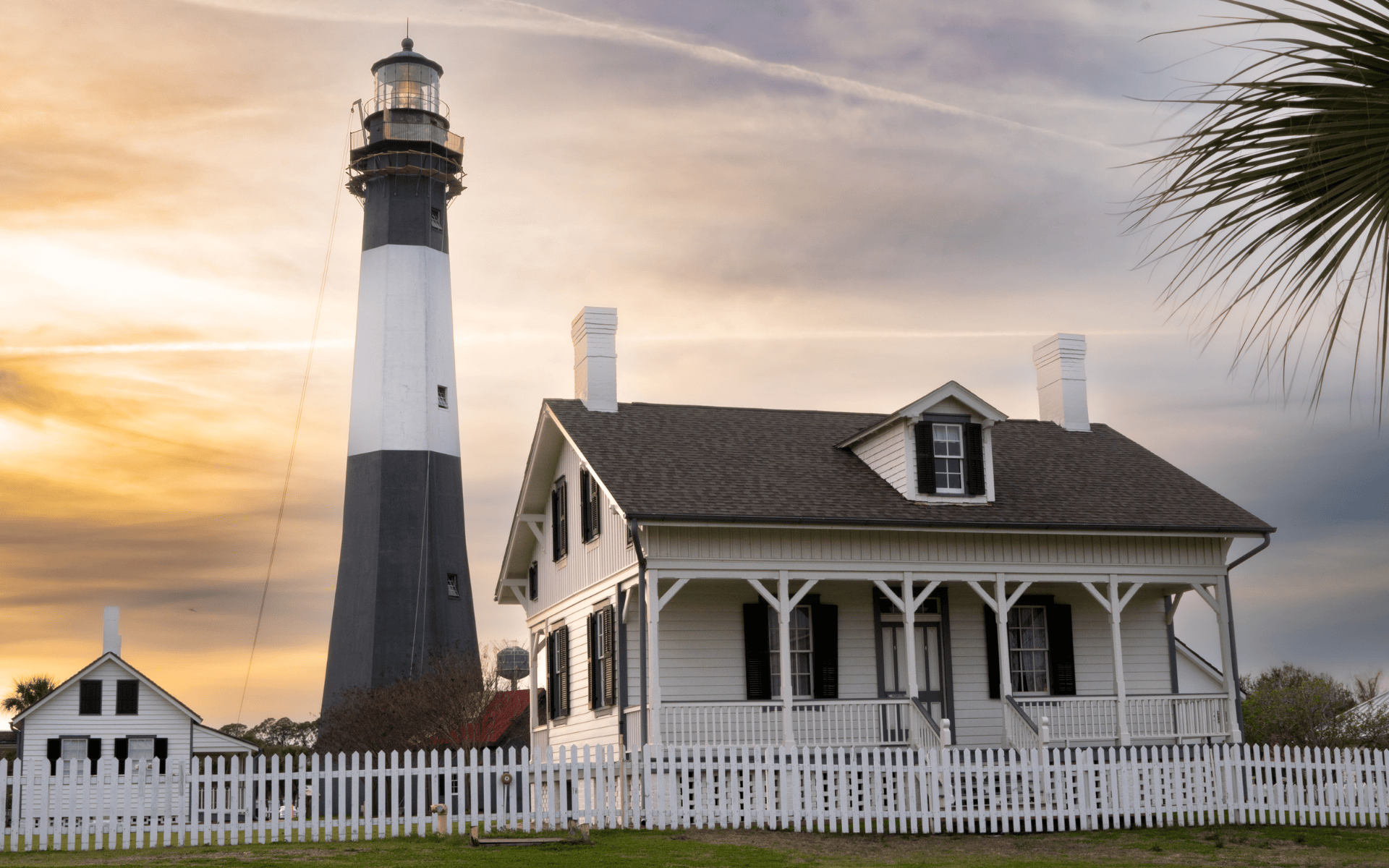
1. Tybee Island Light Station and Museum
The Tybee Island Light Station is Georgia’s oldest and tallest lighthouse, and it has guided ships into the Savannah River since the colony’s earliest years. General James Oglethorpe ordered the first tower in 1732, and the light station was established in 1736. The tower has been rebuilt several times since then. The version you see today was first lit in 1867 and stands about 145 feet tall, with the black and white day mark it has worn since 1916.
How many steps are in the Tybee Island Lighthouse? There are 178 steps to the top, with a landing every 25 steps where you can rest and look out a window. There is no elevator, so wear flat, comfortable shoes if you plan to climb. Your reward at the top is a sweeping view of Tybee Island, the Atlantic Ocean, and the mouth of the Savannah River.
What else is at the light station? The three-acre site is one of the most intact light stations in the country, with its original support buildings still standing. Your ticket also covers the Tybee Island Museum, housed inside Battery Garland, a Spanish-American War era fortification that was part of Fort Screven. The museum covers Tybee’s history from Native American settlement through World War II.
How far is the Tybee Lighthouse from downtown Savannah? It’s roughly 18 miles east, or about 25 to 30 minutes by car along Highway 80. The light station is closed on Tuesdays, tickets are sold on-site only, and backpacks are not allowed inside. Check current hours and admission at tybeelighthouse.org before you go.
2. Wormsloe State Historic Site
Wormsloe is home to the oldest standing structure in Savannah: the tabby ruins of Noble Jones’s fortified house. Jones was an English carpenter who arrived with James Oglethorpe and Georgia’s first colonists in 1733. On the Isle of Hope, he built a fortified home from tabby, a mix of lime, sand, and oyster shells, as part of a chain of defenses protecting Savannah from Spanish attack to the south.
Why is Wormsloe famous? Most people know it for its oak avenue, a road that runs about a mile and a half from the 1913 stone entrance arch to the historic site, lined with more than 400 live oaks draped in Spanish moss. Wymberley Jones De Renne, a descendant of Noble Jones, planted the oaks in the 1890s. It’s one of the most photographed spots in Georgia, and yes, you can drive the full length of it.
What can you see at Wormsloe besides the oak avenue? Past the avenue, you’ll find a small museum with artifacts uncovered on the property, a short film on Georgia’s founding, a reconstructed colonial life area, and walking trails through maritime forest to the tabby ruins. The Wormsloe House itself is still privately owned by Jones’s descendants and is not open to visitors.
How long should you plan to spend at Wormsloe? Give yourself at least an hour and a half to drive the avenue, see the museum, and walk to the ruins. Wormsloe is about 10 miles southeast of downtown on Skidaway Road. It is part of the Georgia State Parks system, so check gastateparks.org for current hours and fees.
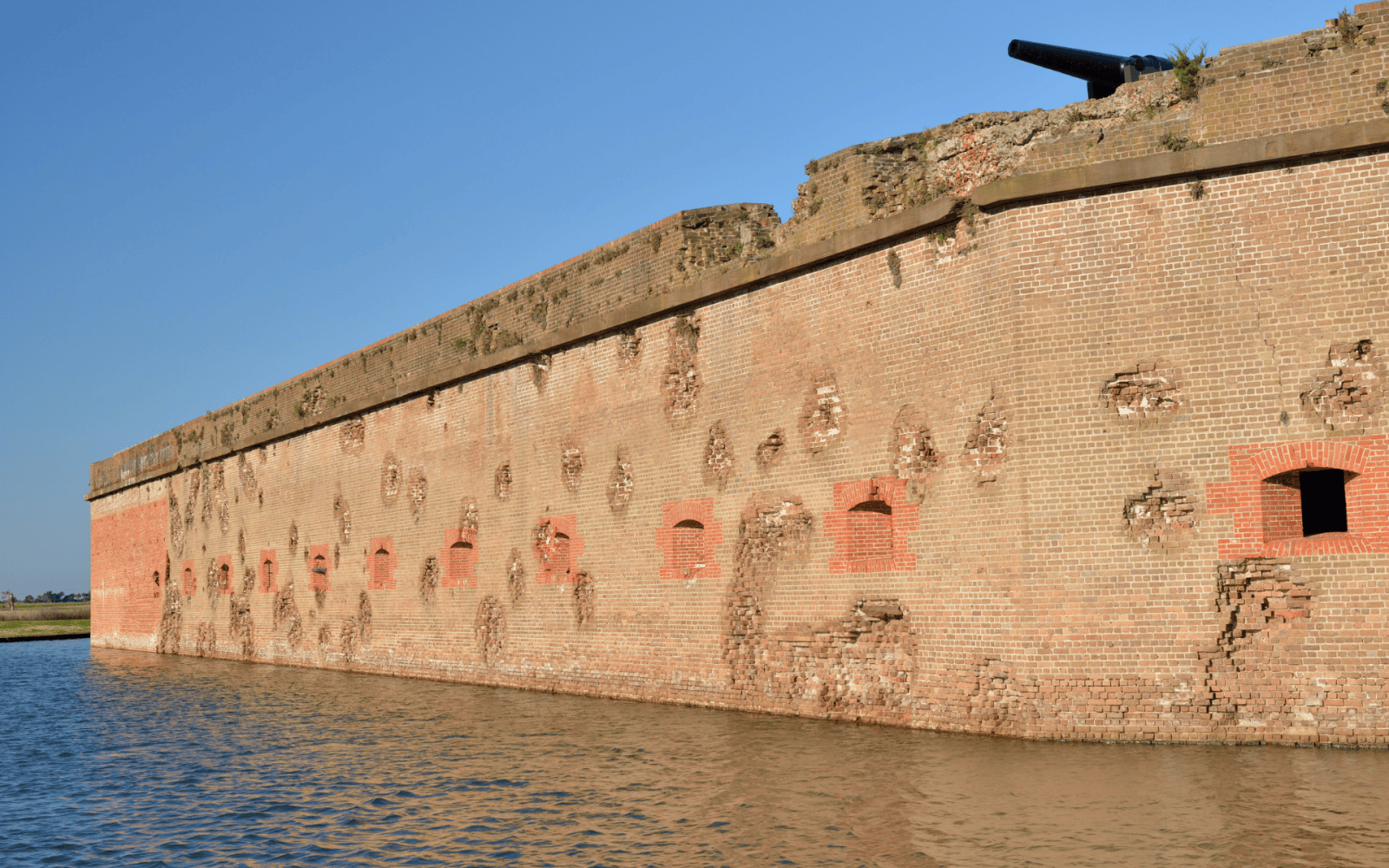
Exterior fort wall of Fort Pulaski showing the cannon and damaged facade by water.
3. Fort Pulaski National Monument
Fort Pulaski is where military history changed in a single day and a half. Built between 1829 and 1847 on Cockspur Island to guard the mouth of the Savannah River, the massive brick fort was considered nearly impossible to breach. Its walls were about seven and a half feet thick, and its designers believed no cannon could do real damage from a distance.
What happened at Fort Pulaski? Confederate forces held the fort when the Civil War began. On April 10, 1862, Union troops stationed on Tybee Island opened fire using new rifled cannon, which could fire farther and more accurately than older smoothbore guns. After about 30 hours of bombardment, the southeast wall was breached, and Confederate Colonel Charles Olmstead surrendered. The battle proved that brick masonry forts were obsolete, and it reshaped how coastal defenses were built around the world.
Can you still see the damage at Fort Pulaski? Yes. Shell holes from the 1862 bombardment are still visible in the fort’s walls, and you can walk through the casemates, cross the drawbridge over the moat, and stand on the ramparts overlooking the river. The grounds also include trails and marsh views on Cockspur and McQueens Islands.
Where is Fort Pulaski, and how long does a visit take? The national monument sits off Highway 80 on the way to Tybee Island, about 15 miles east of downtown Savannah, which makes it an easy stop on the same trip as the Tybee Lighthouse. Plan for one to two hours. It’s run by the National Park Service, so check nps.gov/fopu for current hours and entrance fees.
4. Fort McAllister State Park
Fort McAllister is considered the best-preserved earthwork fortification of the Confederacy. Built beginning in 1861 on the south bank of the Ogeechee River, it was made from sand and mud rather than brick, and that turned out to be its strength. The earthen walls absorbed repeated attacks from Union ironclads during the war without falling.
Why is Fort McAllister important? Its capture marked the end of General William T. Sherman’s March to the Sea. On December 13, 1864, Union troops stormed the fort from the land side, and it fell after a brief but intense fight. Taking Fort McAllister opened a supply line between Sherman’s army and the Union fleet offshore. About a week later, Sherman’s troops entered Savannah.
What can you see at Fort McAllister today? You can walk the restored earthworks, see cannon positions, a hotshot furnace, the bombproof shelter, and palisades. A small Civil War museum on site holds artifacts and a short film. The park was saved in part thanks to Henry Ford, who owned land and a winter home in nearby Richmond Hill and helped restore the fort in the 1930s.
How far is Fort McAllister from Savannah? The park is in Richmond Hill, about 25 miles south of downtown, or roughly 35 to 40 minutes by car off I-95. The 1,700-acre park also has campsites, cottages, picnic areas, and trails through live oaks and salt marsh, so it’s an easy place to spend a full afternoon. Check gastateparks.org for current hours and fees.
5. Old Fort Jackson
Old Fort Jackson is the oldest standing brick fort in Georgia, and it sits right on the Savannah River just a few miles east of downtown. Construction began in 1808 on the site of an earthen Revolutionary War battery known as Mud Fort. The fort was named for James Jackson, a Revolutionary War soldier and Georgia governor, and it guarded the city during the War of 1812 and the Civil War.
What happened to Fort Jackson during the Civil War? It served as the headquarters for Savannah’s Confederate river defenses. When Sherman’s army reached Savannah in December 1864, Confederate troops abandoned the fort. The moat, drawbridge, and brick barracks you see today largely date to an expansion between 1845 and 1860.
Does Old Fort Jackson still fire its cannons? Yes, and it’s the main reason many people visit. The fort holds regular cannon firing demonstrations, led by staff in period clothing who explain how soldiers loaded and fired the guns. The fort’s collection includes a 9-inch Dahlgren, one of the largest working pieces of pre-Civil War heavy artillery in the country, along with artifacts recovered from the CSS Georgia, a Confederate ironclad.
Is Old Fort Jackson worth visiting if you’ve already seen Fort Pulaski? It is. The two forts tell different parts of the same story, and Fort Jackson’s live demonstrations make it especially good for kids and families. It’s only about five minutes from downtown on the road toward Tybee, so it fits easily before or after a trip to the island. The fort is operated by the Coastal Heritage Society; check chsgeorgia.org for current demonstration times and admission.
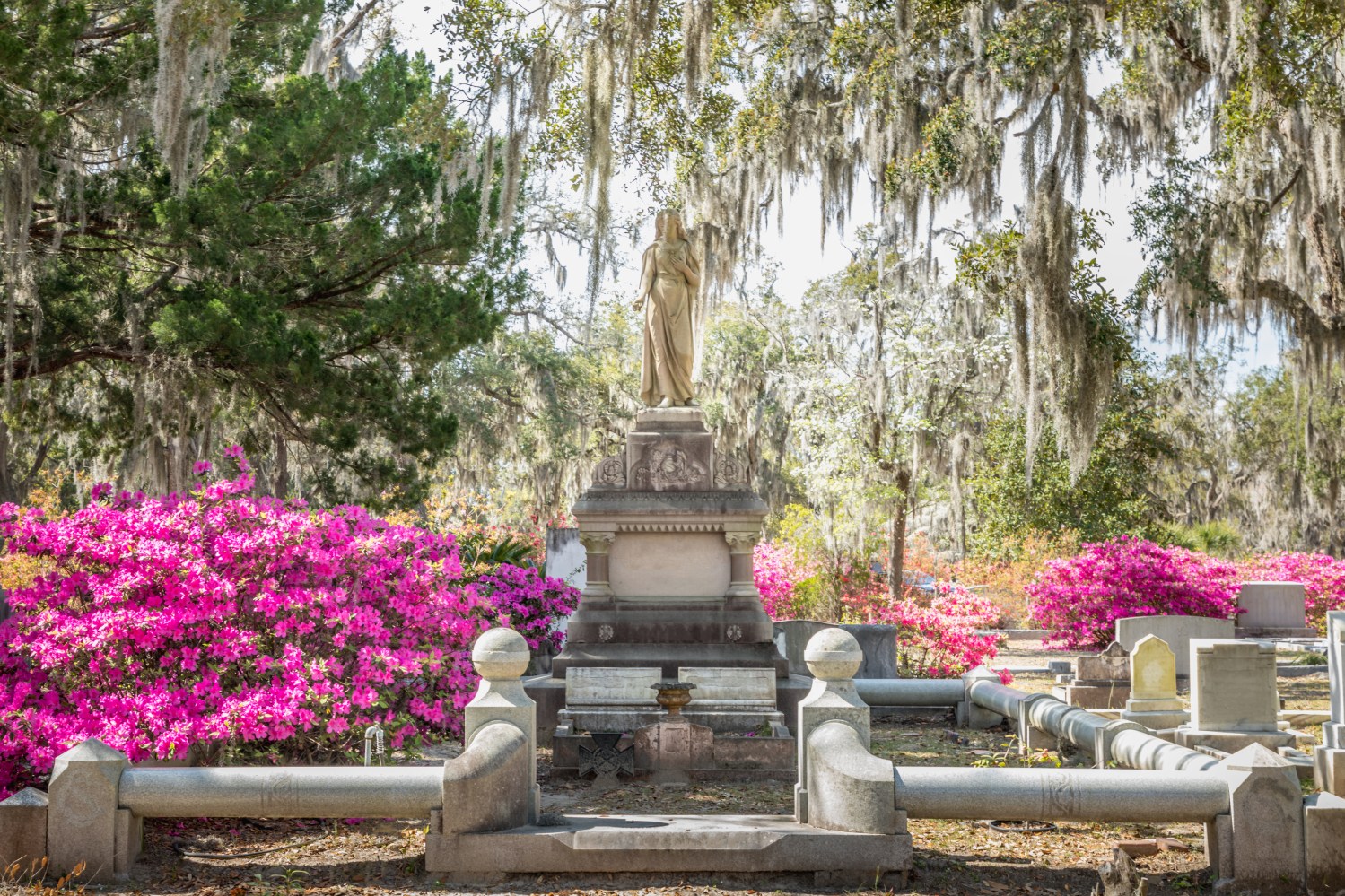
Old historic gravesites amongst azaleas in Bonaventure Cemetery Savannah, Georgia
6. Bonaventure Cemetery
Bonaventure Cemetery is one of the most beautiful and most visited cemeteries in the South. Set on a bluff above the Wilmington River, its roughly 100 acres were once a plantation called Bonaventure, Italian for “good fortune.” Today the grounds are known for towering live oaks, Spanish moss, and detailed Victorian era statues and monuments.
Who is buried in Bonaventure Cemetery? Some of Savannah’s best-known names rest here. Songwriter Johnny Mercer, a Savannah native who won four Academy Awards and wrote the lyrics to “Moon River,” is buried in the family plot. You’ll also find poet Conrad Aiken, Georgia’s first governor Edward Telfair, and the statue of Little Gracie Watson, one of the cemetery’s most beloved sites. Bonaventure gained wider fame after appearing in “Midnight in the Garden of Good and Evil.”
Is Bonaventure Cemetery free to visit? Yes. Admission is free, and the cemetery is generally open daily from 8 a.m. to 5 p.m. You can explore on your own using a map from the visitor center, or join one of the free guided tours offered by the Bonaventure Historical Society on select weekends.
How far is Bonaventure Cemetery from downtown Savannah? It’s about three miles east of the Historic District, near Thunderbolt, and there is no public transit to the gates, so plan to drive or use a rideshare. Morning visits are cooler and quieter, and spring brings blooming azaleas. Please remember Bonaventure is an active cemetery, so be respectful of families visiting loved ones. Learn more at bonaventurehistorical.org.
7. Pin Point Heritage Museum
The Pin Point Heritage Museum tells the story of a Gullah Geechee community that lived and worked on the water for nearly a century. Pin Point was founded in the 1890s by first-generation freedmen on the banks of the Moon River, just south of Savannah. The Gullah Geechee culture grew from West African traditions carried by enslaved people to the Georgia and South Carolina coast, and it shaped the community’s language, faith, food, and way of life.
What is the Pin Point Heritage Museum? The museum is housed in the restored A.S. Varn & Son Oyster and Crab Factory, which opened in 1926 and employed much of the community until it closed in 1985. Exhibits walk you through how oysters and crabs were harvested, processed, and shipped, alongside oral histories, photographs, and artifacts shared by people who grew up in Pin Point. The waterfront setting, with marsh views from the old factory buildings, is part of the experience.
Why is Pin Point significant? It’s one of the few remaining Gullah Geechee communities in coastal Georgia, and much of its history was passed down through memory rather than written records. Pin Point is also the boyhood home of U.S. Supreme Court Justice Clarence Thomas, whose mother worked at the Varn factory, but the community’s story reaches far beyond any one person.
When can you visit the Pin Point Heritage Museum? The museum keeps limited weekly hours, so check chsgeorgia.org before you go. It’s about 12 miles south of downtown and just a few minutes from Wormsloe, which makes the two an easy pairing for a morning or afternoon.
8. National Museum of the Mighty Eighth Air Force
The National Museum of the Mighty Eighth Air Force honors a unit with deep Savannah roots. The Eighth Air Force was activated in Savannah on January 28, 1942. It started with only a handful of men and no aircraft, then grew into one of the largest air forces of World War II, flying B-17 and B-24 bombers from bases in England in the campaign against Nazi Germany.
What can you see at the Mighty Eighth Air Force Museum? The museum covers more than 90,000 square feet of exhibits. Its centerpiece is the B-17 Flying Fortress “City of Savannah,” which the museum acquired in 2009 and has restored inside its combat gallery. You can see what life was like inside the cramped quarters of a bomber, learn about the dangers of high-altitude missions and the prisoner of war experience, and sit in on a recreated mission briefing. Outside, the Chapel of the Fallen Eagles and the memorial gardens offer a quiet place to reflect.
Is the Mighty Eighth Air Force Museum good for kids and families? Yes. The aircraft, interactive exhibits, and personal stories from airmen make it engaging for a wide range of ages, and it’s an especially meaningful stop for veterans and military families. Plan for at least two hours.
Where is the Mighty Eighth Air Force Museum? It’s in Pooler, right off I-95 at Exit 102, about 15 to 20 minutes west of downtown Savannah and close to the Savannah/Hilton Head International Airport. That makes it an easy first or last stop if you’re flying in or out. Check mightyeighth.org for current hours and admission.
How to Plan Your Day Trips From Downtown Savannah
Can you see several of these historic sites in one day? Yes, if you group them by direction. Most fall along two easy routes from downtown.
Heading east toward Tybee: Start at Bonaventure Cemetery, stop at Old Fort Jackson for a cannon firing, continue to Fort Pulaski, and finish at the Tybee Island Light Station. This route works well as a full day, and you can end it with dinner and a sunset on the island.
Heading south: Pair Wormsloe and the Pin Point Heritage Museum, which are only minutes apart. If you have a full day, continue on to Fort McAllister in Richmond Hill.
Heading west: The Mighty Eighth Air Force Museum in Pooler is right off I-95 near the airport, so save it for the day you arrive or the day you leave.
Do you need a car to visit historic sites outside downtown Savannah? For most of them, yes. Public transit doesn’t reach these sites easily, so a car or rideshare is the simplest way to get around. Hours and admission change by season, so check each site’s official page the day before you go.
If you’re looking to discover as much as you can about Savannah, from its history to its best restaurants, and want the inside scoop on things to do while you’re here, schedule one of our downtown tours!